Search “best AI books” and you'll get the same ten titles on every list, in roughly the same order, with roughly the same one-line descriptions. Most of them are good books. Almost none of the lists tell you which one is right for you.
So instead of ranking by popularity, here are six AI books worth your time in 2026, organized by what you're actually trying to get out of one.
If you want to make money with AI this month — not understand it in theory
AI Is Making People Money. Here's How. by Eric Coste is the one book on this list that isn't trying to explain AI — it's trying to get you to a first dollar. Thirteen chapters cover eight real income models (services, digital products, content, affiliate marketing, automation, tools, freelancing, and using AI inside a business you already run), plus 50 copy-paste prompts and a 30-day action plan. No coding, no audience required.
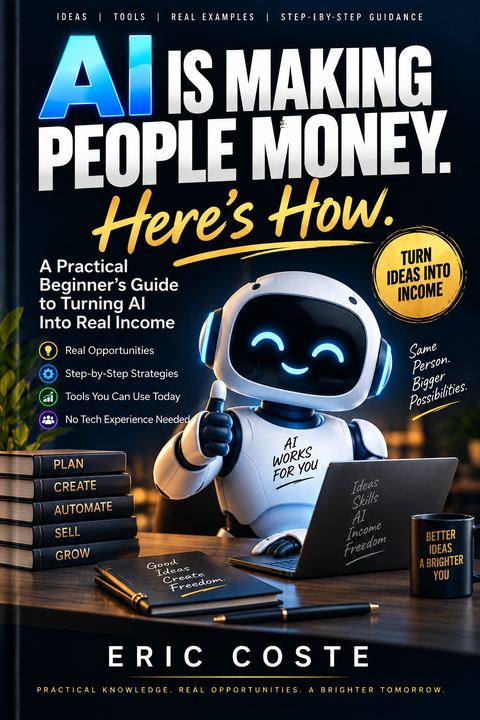
It's deliberately narrow. If you want the philosophy or the history of AI, skip to the next section — this book assumes you already believe AI is useful and just want the specific steps to turn that into money.
If you want one book that actually explains how to work with AI
Co-Intelligence by Ethan Mollick (Wharton professor, one of the most-cited voices on practical AI use) is the best single book on developing good judgment about when and how to use AI tools well. It's less “here's a list of tools” and more “here's how your thinking needs to change.” Read this if you already use ChatGPT daily but suspect you're only using 20% of what it can do.
If you want the big-picture, where-is-this-going view
The Coming Wave by Mustafa Suleyman (co-founder of DeepMind and Inflection AI) is the most credible “where this is all heading” book, written by someone who actually built the technology rather than just writing about it. Dense in places, but worth it if you want the strategic altitude view, not just the practical one.
If you want to actually understand how the technology works, without the math
You Look Like a Thing and I Love You by Janelle Shane is the most fun book on this list, and also one of the clearest explanations of how machine learning actually behaves — including all the weird, funny ways it fails. Good for genuine beginners who want intuition, not equations.
If you're building or leading a business around AI
Prediction Machines by Ajay Agrawal, Joshua Gans, and Avi Goldfarb reframes AI as fundamentally an economics-of-prediction problem — which sounds academic but turns out to be the clearest lens for figuring out where AI actually creates business value versus where it's just noise.
If you want the risk-and-philosophy side of the conversation
Superintelligence by Nick Bostrom is heavier and older (2014) than everything else here, but it's still the reference point most serious AI-risk conversations trace back to. Not a beginner book — include it once you've read one or two of the others and want the deeper end of the pool.
The honest takeaway: most “best AI books” lists exist to rank well on Google, not to help you pick. Pick based on what you're actually trying to do — understand, strategize, or earn — and read one book all the way through instead of three books halfway.
FAQ
It depends what “beginner” means to you. If you want to understand AI conceptually, start with You Look Like a Thing and I Love You. If you want to start earning money using AI tools, start with AI Is Making People Money. Here's How. — it assumes zero prior AI experience.
Yes — it's written specifically for people with no coding background, no existing audience, and no prior AI experience. Every model in the book uses AI assistants like ChatGPT or Claude, not custom development.
The tool-specific details age fast; the underlying frameworks don't. Books like Co-Intelligence and AI Is Making People Money focus on how to think about and work with AI rather than which specific model is best this month, which is why they hold up.