If you're looking for a number — “the average AI book makes $X per month” — that number doesn't exist in any meaningful sense, and anyone giving you one confidently is guessing. What does exist is a clear pattern in which AI-assisted books make money and which don't, and it has almost nothing to do with AI.
The uncomfortable truth: it's the same pattern as pre-AI self-publishing
Self-publishing has always had a power-law outcome: a small number of books make real money, most make very little, and the difference was never really about writing talent. It was about whether the book solved a specific problem for a specific, findable audience — or was one more generic entry in an oversaturated category.
AI didn't change that pattern. It changed how fast you can produce a book, which means it's now trivially easy to flood a category with generic content — and just as easy to produce a genuinely useful, narrow, well-targeted one. The tool is the same; the strategy decides the outcome.
What separates the books that make money
- Niche specificity. “A book about productivity” loses to “a book about time-blocking for ADHD freelancers.” The narrower book has less competition and a buyer who recognizes themselves in the title.
- A real editing pass. Books that get edited — restructured, fact-checked, given a real voice — read nothing like raw AI output, and readers can tell the difference within a page.
- Positioning before writing. The books that sell were positioned (title, cover, category, price) before a word was drafted, not after. AI makes drafting fast; it doesn't make positioning for you.
- A launch, not a hope. Publishing a book and waiting for Amazon's algorithm to find it is the single most common reason a good book makes $40 in its first year. Books that make money get put in front of actual people first.
What doesn't matter nearly as much as people think
Whether the first draft came from AI or from you typing it yourself matters far less than most debates on this suggest. A well-edited, well-positioned, well-launched AI-assisted book will outsell a poorly-positioned human-written one every time — and vice versa.
The honest framing: “Do AI books make money” is the wrong question. “Does this specific book solve a specific problem for a specific person, positioned correctly, and put in front of people who'd actually buy it” is the right one — with or without AI in the drafting process.
If you want the actual formula, not just the theory
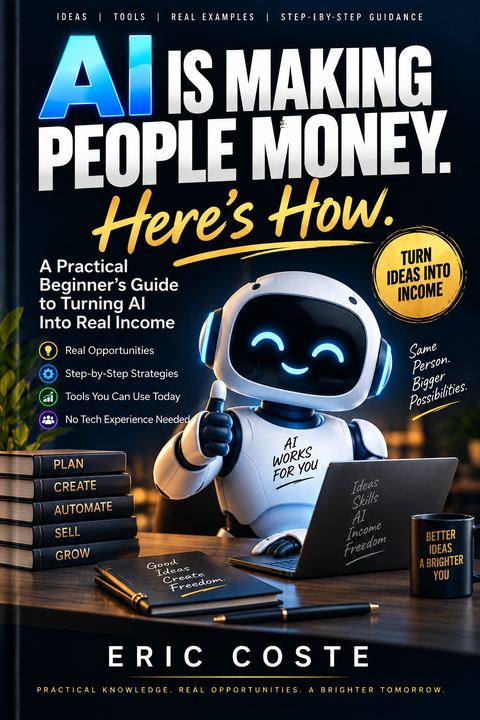
AI Is Making People Money. Here's How. walks through the exact process — finding a specific opportunity, turning it into an offer, and finding the first 20 people who'd pay for it — applied across eight income models, of which AI-assisted digital products (books included) is just one.
FAQ
Most first books, AI-assisted or not, make very little — often under $100 in the first year. The exceptions are narrowly targeted books with a real launch strategy, not broad, generic topics.
The overall category is more crowded, since AI lowered the cost of producing a book. That makes niche specificity and quality editing more important than they were before, not less.
No — you need a small number of the right people, not a large audience. Twenty genuinely interested readers who buy and leave honest reviews outperforms a broad, indifferent audience of thousands.